Posted on Leave a comment

Tiramisu: Reserved Only for the Bestest

P2335
P2334
P2333
P2331
P2332

Posted on 2 Comments

How Sweet It Is (To Be Loved By You)

A post from my private blog published exactly four years ago on this day (on Tuesday, September 09, 2008), published here today to reflect and rejoice in the gift of life and love.

How Sweet It Is (To Be Loved By You)


Meenu or Minharest Minz came to us when he was about ten years old, all the way from the great state of West Bengal.  His father was a very tall and lanky man and appeared to be from tribal stock of the 24 Parganas area.  Semi-literate, he was a farmer, he said, and Meenu was the older of his two children.  The basic facts were:  they were very poor; the mother had recently passed away; the father had remarried; the father had heard about our Children’s Home and wanted to give Meenu a better future (and presumably keep him at arm’s length from the new wife).  And so, Meenu said goodbye to his father, and stayed with us.  I was Didi, of course, to all the kids, and that’s what Meenu called me too.


His Bengali was soon replaced with our local UP Hindi, and like his father, he soon began to grow into a real tall boy.  He was always a very good boy (never getting into trouble like the other kids!), and since he was somewhat older than most of the kids, they all called him Meenu Bhaiyya.  He would take on leadership tasks, and was one of the dependable kids giving a second pair of eyes to my folks!  When he got older, he had the privilege of riding my father’s bicycle into town to run small errands.  (My father, BTW, took great pride in his ever-shiny Hercules bicycle, in addition to his Lambretta scooter and Fiat Padmini Premier motor car!)  After Meenu finished high school, he went on to a Vocational/Technical school and got himself a decent job in town.  Some years later, he married a girl from our Home (and no, there was no hanky-panky going on while they were both kids growing up together!), and today, he appears to be happily married and living in Saharanpur, and has two little boys:  Aviral and Vishesh.


Meenu is a sweetheart, and over the years, has sent me numerous presents (it has come to a point where my parents don’t like to tell him that they’re coming to see me because he presses upon them some very large-sized item that they then find difficult to pack into their suitcases!), usually some exquisitely hand-carved thing like a candlestick stand or a picture frame or such.  He remembers my every birthday, and I can always rest assured that there’ll be a card in the mail for me.  He even calls me every now and then– just to say hello!  


So, when he learnt that I was coming to India this summer, he obviously wanted me to come to Saharanpur.  And I sure did want to go too, but turned out that the time was too short and I was already trying to squeeze in so much.  So sweetheart that he is, Meenu offered to come down to Delhi to see me!


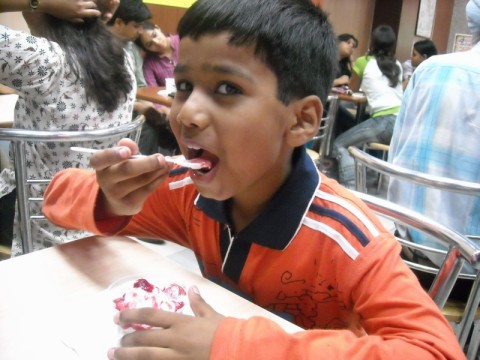
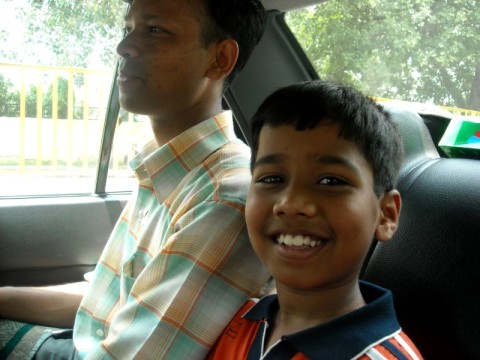
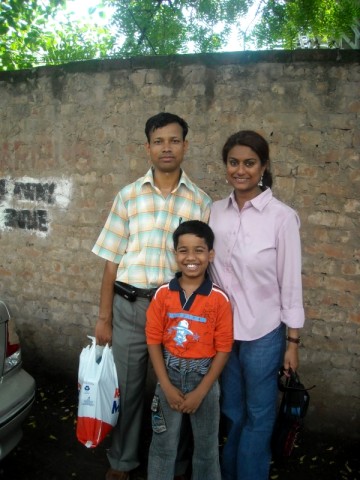
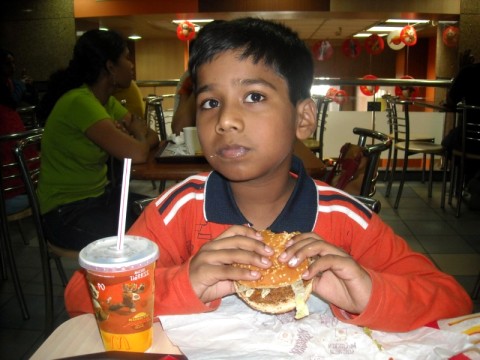
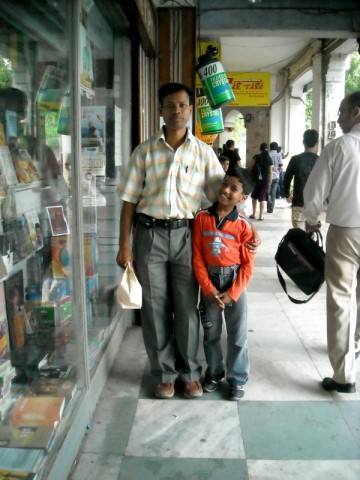
Here he is with his older son, Aviral who, BTW, was seeing the big city (and the nation’s capital, at that!) for the very first time.  The three-hour train ride was a treat for him, as were the sights and sounds of Dilli, but (and I’m hoping this was the case!) so was meeting Simmi Didi for the first time!


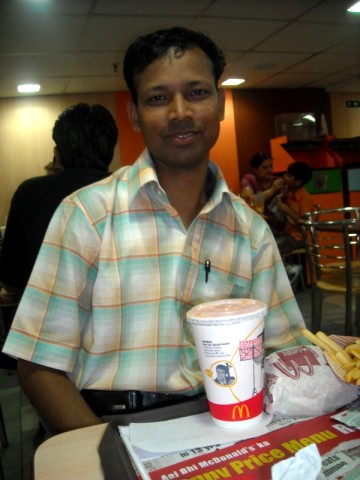
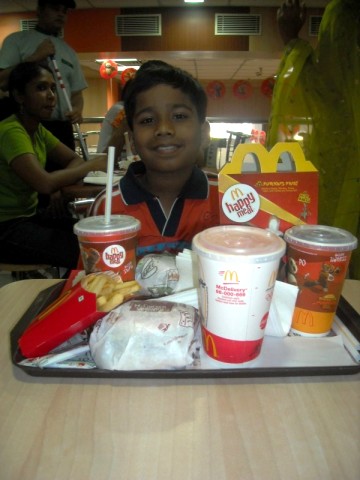
And so here we are:  catching up at the McDonald’s in Connaught Place.   Didn’t feel like we hadn’t seen each other in ten years (which is how long it had really been since we last met b/c I couldn’t meet him on my last visit prior to this one); we laughed and talked and lived in the moment for those few hours.  He brought gifts as always for everyone, and we exchanged these with glee!


Amazing– this thing called love.  When it grabs you, it doesn’t let go.  And it transcends time and space and generations, even.


Like James Taylor says:  how sweet it is to be loved by you!

Meenu-5

Posted on 1 Comment

Simple Treatments, Ignored: Why Blood Pressure Isn't In Check

Simple Treatments, Ignored

A new federal health analysis has found that 36 million adults in the United States have high blood pressure that is not being controlled even though 32 million of them get regular medical care and 30 million of them have health insurance.

This is not primarily a case of poor, uninsured people unable to get the care they need. It is shocking evidence of how our complicated, dysfunctional health care system can’t deliver recommended care to many patients who could benefit, because their doctors are asleep at the switch. As a result, patients go on to suffer medical harm and their care inflicts big costs on the health care system.

Health authorities recommend that people whose blood pressure reaches 140/90, a condition known as hypertension, take steps to bring it down by dietary changes, exercise or medications. The reasons are compelling. People with high blood pressure are four times as likely to die of stroke and three times as likely to die of heart disease as people with normal blood pressure. They are also prone to kidney failure. Their health care costs related to high blood pressure exceed $130 billion year.

The new analysis, issued last Tuesday by the Centers for Disease Control and Prevention, found that 67 million Americans had high blood pressure and that 31 million of them were being treated with medicines that reduced their blood pressure to a safe level. The remaining 36 million fell into three groups: people who were not aware of their hypertension, people who were aware but were not taking medication, and those who were aware and were treated with medication but still had hypertension.

This is an abysmal record for a condition that is easy to detect and treat. In some cases, patients had multiple high blood pressure readings entered into their electronic medical records but nobody told them about their condition or put their names on a list to be contacted for treatment. They fell between the cracks, even in some of the nation’s most respected health care systems, mostly because overburdened doctors did not give hypertension high priority.

Dr. Thomas Frieden, director of the C.D.C., said health care providers who make reducing high blood pressure among patients a top priority can quickly bring it under control. He pointed to Kaiser Permanente, a multistate managed care consortium, as one that has had real success on this front.

Kaiser Permanente says that in Northern California it increased the percentage of patients whose hypertension was under control from 44 percent in 2001 to 87 percent in 2010. Over approximately the same period, stroke mortality declined by 42 percent, heart attacks by 24 percent and the most serious type of heart attack by 62 percent. The organization created a hypertension registry to track patients and the care they were getting; eased the burden on doctors by using pharmacists to initiate drug therapy and medical assistants to monitor patients’ progress; made it easy for patients to get free blood pressure checks; and showed doctors how their record on controlling blood pressure compared with others in the system.

Federal health officials have set an ambitious goal to reduce the population with uncontrolled high blood pressure by 10 million within five years. In most cases, they believe, medication will need to be part of the treatment. There is little doubt that drugs are beneficial in treating patients who have severe cases of hypertension (a systolic blood pressure of 160 or more). But for some patients who have milder hypertension (systolic blood pressure from 140 to 159), the benefits may not be as obvious or may be outweighed by drug side effects.

The United States Preventive Services Task Force, a group of independent health experts that advises the Department of Health and Human Services, has found good evidence that treating high blood pressure with medication would decrease cardiovascular problems while causing few major problems. It also supports other approaches, like weight loss, increased physical activity, lower sodium and alcohol consumption, and stress management. The benefits of reducing high blood pressure — not to mention the cost savings — are obvious. The wonder is that the health care system has done such a bad job of delivering those benefits.

Bloodpressure


Posted on Leave a comment

On This Day: September 9

Updated September 8, 2012, 2:28 pm

NYT Front Page

On Sept. 9, 1976, Communist Chinese leader Mao Tse-tung died in Beijing at age 82.

Go to article »

On Sept. 9, 1887, Alfred Landon, the American politician who ran against Franklin Roosevelt for United States president in 1936, was born. Following his death on Oct. 12, 1987, his obituary appeared in The Times.

Historic Birthdays

Alfred Landon 9/9/1887 – 10/12/1987 American governor of Kansas (1933-7) and unsuccessful Republican presidential candidate (1936).Go to obituary »
61 Luigi Galvani 9/9/1737 – 12/4/1798
Italian physician and physicist
63 William Bligh 9/9/1754 – 12/7/1817
English admiral; commanded the HMS Bounty
74 Fremont Lawson 9/9/1850 – 8/19/1925
American newspaper editor and publisher
70 Max Reinhardt 9/9/1873 – 10/31/1943
Austrian stage and screen director
69 James Agate 9/9/1877 – 6/6/1947
English drama critic for the London Sunday Times (1923-47)
54 James Hilton 9/9/1900 – 12/20/1954
English novelist
80 Granville Hicks 9/9/1901 – 6/18/1982
American critic, novelist and teacher
26 Otis Redding 9/9/1941 – 12/10/1967
American soul singer and songwriter
44 John Curry 9/9/1949 – 4/15/1994
English Olympic gold medal-winning figure skater (1976 )