Posted on Leave a comment

(Birthday) Samosas From Scratch

Samosas

So, what’s as special as cake on your birthday?  Well, if you’ve got a thing for samosas– homemade ones at that– then you’d probably want those for your birthday!

Which is what a friend of my firstborn asked for as a birthday present!

So, next thing I knew, I was being recruited to “help” make them! 

We made two kinds:  one batch with a traditional potatoes-and-peas filling, and the other with a keema-and-peas filling. 

And when I say scratch, I mean scratch from the very scratchiest scratch.  That included kneading the dough, rolling it for the wrappers, making the two fillings, preparing each samosa in the traditional triangular shape, crimping the edges, and finally frying them to a golden brown.

See the slideshow below if you’re in the mood for a DIY.  And good luck!

Posted on Leave a comment

More Than Just Chutney

Pastasuprema1

Time to dig up these old posts… this one from a couple years ago, first published on Tuesday, December 09, 2008.

So, I’ve been experimenting with creating chutneys of different kinds: tomato, coconut, peanuts, different dals, pudina, and other green chutneys. And its been a load of fun. It’s truly a work of art each time! Seriously.  And what’s more, and I’ve known this all along, really, but still: a chutney isn’t just a condiment to enhance flavor on the side. It can actually become a key ingredient in the creation of a dish all to itself.

Take for example this absolutely fantastic pasta dish I created yesterday: I added as the key seasoning several dollops of my tomato chutney (made with tons of roasted garlic, cumin, onions, dry red chillies, karipatta, some chana dal, and tomatoes of course– all blended together and then tempered with a tadka of desi ghee) to a stir-fry of mixed veggies and diced boneless chicken tenderloin (marinated in homemade yogurt and spices), and folded it all in with whole-wheat spaghetti cooked separately.

The result? Fantastico! The Italians would kill for it. As would the Greeks, the Argentinians, the Chinese, the Japanese, the Koreans, the Indonesians, and of course, the Indians!

See for yourself! Is that art, or that art?! And if you think the sight of this is an assault on the eyes, I wish that you could have only smelled the gorgeous flavors that wreaked havoc on the rest of the faculties!

So, here’s to chutney today. Remember, its so much more than just that. It’s the very essence of the dish, without which this pasta suprema dish would be nothing more than a bland weekday dinner.

May it be, that just like this chutney, we pause to look for and recognize the various things in life that may appear ordinary and peripheral, but are, in fact, what makes life special.

Posted on Leave a comment

Steven Smith: On Brewing a Perfect Cup of Tea

Media_httpwwwapartmen_pehsa

I love tea as much as I love coffee– and maybe just a little bit more! My current favorite in the office is Hot Cinnamon Spice.

Posted on Leave a comment

Master Mixology: Cognac Cocktails

Media_httpihuffpostco_kxhmd

You may think of the famed French brandy as a sipping spirit, but cognac has a long mixological history. In fact, it was an extremely popular ingredient in the early 1800s, when the cocktail was born. Since its flavor combines deliciously with fruits and juices, cognac is the backbone of a wide range of both classic and modern drinks. Here are some of our favorites.

I might try that Apple Toddy myself sometime!

Posted on Leave a comment

Native To India

Cutbaingan

Another old post dug out to be published here.  First published on Thursday, December 11, 2008.

I didn’t know that, you know. That the brinjal, or eggplant as it is commonly called in the North American continent is native to India. Well, not a big surprise this is, given that it is such a commonly available and frequently cooked veggie in India.

I cooked some today myself. And so fascinating did I find the lovely bright purple coloring of the small fruit (they’re technically a fruit, you see!), that I couldn’t help but pull out my camera and take a picture!

BTW, these are in water. That’s how my mother taught me to cut and handle eggplant. Always put them into water so they won’t oxidize and turn a dirty grayish-brownish hue.

In India, we get the small variety with the thorns on the stem. These are generally trimmed off and slit right from the top of the stem into halves or fourths without going all the way down the entire egglpant, thereby leaving each one still whole, but with several slits that absorb all the masalas while cooking.

Well, I usually cut them up like that, but today, I decided to take my knife all the way down the length of each one and made nice long slices. Soaking in this lovely stainless-steel tray (new one that I brought back from India this past summer!), they look like the perfect model for a lovely still-life drawing!

I think it was my grandmother who used to say that the brinjal is the king of the vegetables– hmm… I don’t know if I’d argue with her because I gotta say this is one versatile and yummy and a good-for-you veggie that can be made in a multitude of ways.

In Hyderabad, the Bagara Baingan is the traditional sidedish that goes with Biryani. The small ones are used for this: smothered in the most decadent gravy of khuskhus and peanuts and all kinds of garam masala, the baingan look almost too good to eat! But the baingan can also be made in a variety of other more humble ways: I made a simple subzi that has a base of onions, ginger, garlic, tomatoes and some basic masala. Ocassionally, I’ll toss in some potatoes as well, but I didn’t have any today. There are as many themes and variations to making the eggplant as there are differences by region and customs. In the South, it is routinely added to sambar and made into a variety of colombos. 🙂 And beyond India, it is equally popular in other parts of the world as well: in the Middle East, Baba Ghanouj has as its key ingredient– you guessed it: the eggplant. In Italy, Greece, Spain and the rest of the Mediterranean, the eggplant is glorified in all kinds of casseroles and doused with cheese and breadcrumbs and is boiled and baked and even deep-fried.

Well, very interesting it is that the eggplant is native to India. So much India has given to the world! How resourceful its people are to cultivate something good, and then to offer it to the many foreigners who came to its shores so as to allow them to take the seeds back to their own native lands and cultivate it for themselves.

Well, in case you wish to learn more about this wonderful fruit/vegetable, go to: http://en.wikipedia.org/wiki/Eggplant

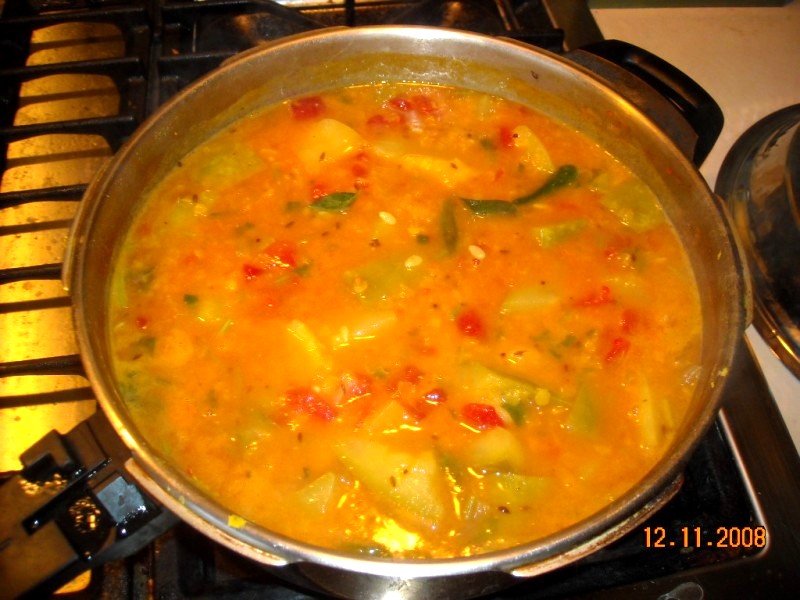
So, like I said, I made some today. Both the before and after pictures are works of art, methinks. 🙂 oh, and that other picture? Well, that’s some yummy dal. Not sambar, now. Just plain dal with some tomatoes and a fantastic tadka. Enjoy!

Posted on Leave a comment

Christmas (Fruit)Cake 2010

Christmascake

So, this is another how-to post:  how-to make a traditional Christmas fruitcake. 

I had the pleasure of making one with my mother this past Christmas.  Enclosed below is a step-by-step slideshow of the ingredients and the process of bringing them together that results in a most incredible cake that lasts for several weeks after it is made.  The pictures are all captioned to tell a story.  Enjoy!


Posted on Leave a comment

Open-Faced Brunch Sandwiches

Brunch

Thanks to the MLK holiday, these open-faced brunch sandwiches seemed to materialize out of nowhere.  Well, out of the left-overs from within the fridge, to be precise.

The main ingredients were:  a loaf of french-bread, pepper-jack cheese, four boiled eggs, and some rotisserie chicken.  Salt, pepper, dijon mustard and butter are staples that almost go unmentioned.

Thick slices of the bread got a thin spread of Olivio butter, followed by the cheese, eggs and the shredded chicken, and finally topped off with a swirl of dijon mustard and a thin slice of butter.

Bake at 400 in a pre-heated oven for five mins; then, broil for another 5.

Serve with love.

A slideshow follows.  Note:  this is our variation of the Danish open-faced sandwiches mentioned in this blog a couple weeks ago.


Posted on Leave a comment

Would That My Tongue

Frittata

This is a post that was first published almost exactly two years ago, on Tuesday, December 30, 2008.  I reproduce it now in order to celebrate the gift of life of which food is the expression of love, among other things.  And especially since this blog has been created to be the repository of all things food.  May it be that you receive as much joy in viewing this post as I did in making each of these things, and reflecting upon them.


As we wrap up another year, it is time to reflect on the time that has passed. Time that has passed us by, and how we have passed it. Our energies and emotions invested in people, places and causes that we believe in; our wherewithal employed in the life of our bodies and minds. Would that it were possible to capture the outcomes of all those investments! Would that it were feasible for our tongues to utter the thoughts that arise from those reflections!

But since our tongues fail us, we are masters of our own creations– to think through the year (and our lives so far) that we are exiting, even as we move forward into another new year– to conjure up for ourselves the moments and events that we would like to bring to pass. May it be that each passing moment (or year) leaves us with a sense of well-being, nay, satisfaction at the least, and fulfillment at best. May it be with a sense of such optimism that we enter this new year of our Lord, Two Thousand and Nine.
The poem? Well, Tennyson is another man after my own heart. I see in this piece not just a wistful reflection of moments of pleasures from the past, but of a life-affirming yearning of more such pleasures to come– pleasures that the tongue cannot utter. How beautiful is that? Yet despite the limitations of the tongue, Tennyson is still so skilled at conveying that which we thought could not be uttered! Walt Whitman, the great American man of letters, says this of Tennyson:
 

Tennyson shows more than any poet I know (perhaps has been a warning to me) how much there is in finest verbalism. There is such a latent charm in mere words, cunning collocutions, and in the voice ringing them, which he has caught and brought out…

Break, Break, Break
Lord Alfred Tennyson

Break, break, break, On thy cold gray stones, O Sea!

And I would that my tongue could utter

The thoughts that arise in me.

O, well for the fisherman’s boy,

That he shouts with his sister at play!

O, well for the sailor lad,

That he sings in his boat on the bay!

And the stately ships go on

To their haven under the hill;

But O for the touch of a vanished hand,

And the sound of a voice that is still!

Break, break, break,

At the foot of thy crags, O Sea!

But the tender grace of a day that is dead

Will never come back to me.

And there’s another purpose to our tongues: the ability to experience the tangible.  Which comes, many a time, in the form of glorious foods. Here are some home-made goodies that yours truly had the pleasure of creating and experiencing just this past week. Here they are, for your viewing pleasure!