
via thekitchn.com
Get your quiche on! And don’t be afraid to improvise! Click on the link below the picture for more.
Creating, collecting, and sharing thoughts and ideas. And learning along the way.
Food is love. Plus art. Oh, and it keeps you alive. That, too! You might not find a single recipe here, but you may find the inspiration to go create one. Unless, of course, you’re left speechless because you’re drooling so severely at the sight of these glorious images. Regardless, you are NOT always what you eat.
Get your quiche on! And don’t be afraid to improvise! Click on the link below the picture for more.

Time for the old posts to come out to the new blog! This one was first published in my private blog on Thursday, December 04, 2008.

On a cold wintery mid-morning, what better a thing to bake than a loaf of my banana-walnut bread? So, here it is. I used a large round pan (actually my cheesecake pan), but technically, I suppose, a loaf pan ought to be used… Well, these things don’t matter too much to me—loaf pans, cake pans, cheesecake pans, square pans, they’re all one and the same. What’s of import is what’s inside them!
The other thing I made just now is choley—with a twist. I added a can of black beans to the standard garbanzo (or chickpeas) beans. Serve it up with hot steaming white rice, and its an entrée fit for a king, don’t you think? 🙂
Lovely blend of East and West in cooking techniques and choice of dishes, no? A slice of the banana-walnut bread will go nicely with a cup of tea or coffee. And the choley will be dinner, of course.
Bon Appetit!

I remember the McAloo Tikki I had in a McDonald’s in Bangalore too! Plus, priceless dialogue from Pulp Fiction on the Royale With Cheese.

So, what’s as special as cake on your birthday? Well, if you’ve got a thing for samosas– homemade ones at that– then you’d probably want those for your birthday!
Which is what a friend of my firstborn asked for as a birthday present!
So, next thing I knew, I was being recruited to “help” make them!
We made two kinds: one batch with a traditional potatoes-and-peas filling, and the other with a keema-and-peas filling.
And when I say scratch, I mean scratch from the very scratchiest scratch. That included kneading the dough, rolling it for the wrappers, making the two fillings, preparing each samosa in the traditional triangular shape, crimping the edges, and finally frying them to a golden brown.
See the slideshow below if you’re in the mood for a DIY. And good luck!

Time to dig up these old posts… this one from a couple years ago, first published on Tuesday, December 09, 2008.
Take for example this absolutely fantastic pasta dish I created yesterday: I added as the key seasoning several dollops of my tomato chutney (made with tons of roasted garlic, cumin, onions, dry red chillies, karipatta, some chana dal, and tomatoes of course– all blended together and then tempered with a tadka of desi ghee) to a stir-fry of mixed veggies and diced boneless chicken tenderloin (marinated in homemade yogurt and spices), and folded it all in with whole-wheat spaghetti cooked separately.
The result? Fantastico! The Italians would kill for it. As would the Greeks, the Argentinians, the Chinese, the Japanese, the Koreans, the Indonesians, and of course, the Indians!
See for yourself! Is that art, or that art?! And if you think the sight of this is an assault on the eyes, I wish that you could have only smelled the gorgeous flavors that wreaked havoc on the rest of the faculties!
So, here’s to chutney today. Remember, its so much more than just that. It’s the very essence of the dish, without which this pasta suprema dish would be nothing more than a bland weekday dinner.
May it be, that just like this chutney, we pause to look for and recognize the various things in life that may appear ordinary and peripheral, but are, in fact, what makes life special.

I love tea as much as I love coffee– and maybe just a little bit more! My current favorite in the office is Hot Cinnamon Spice.

You may think of the famed French brandy as a sipping spirit, but cognac has a long mixological history. In fact, it was an extremely popular ingredient in the early 1800s, when the cocktail was born. Since its flavor combines deliciously with fruits and juices, cognac is the backbone of a wide range of both classic and modern drinks. Here are some of our favorites.
I might try that Apple Toddy myself sometime!

Another old post dug out to be published here. First published on Thursday, December 11, 2008.
I cooked some today myself. And so fascinating did I find the lovely bright purple coloring of the small fruit (they’re technically a fruit, you see!), that I couldn’t help but pull out my camera and take a picture!
BTW, these are in water. That’s how my mother taught me to cut and handle eggplant. Always put them into water so they won’t oxidize and turn a dirty grayish-brownish hue.
 In India, we get the small variety with the thorns on the stem. These are generally trimmed off and slit right from the top of the stem into halves or fourths without going all the way down the entire egglpant, thereby leaving each one still whole, but with several slits that absorb all the masalas while cooking.
Well, I usually cut them up like that, but today, I decided to take my knife all the way down the length of each one and made nice long slices. Soaking in this lovely stainless-steel tray (new one that I brought back from India this past summer!), they look like the perfect model for a lovely still-life drawing!
I think it was my grandmother who used to say that the brinjal is the king of the vegetables– hmm… I don’t know if I’d argue with her because I gotta say this is one versatile and yummy and a good-for-you veggie that can be made in a multitude of ways.
In Hyderabad, the Bagara Baingan is the traditional sidedish that goes with Biryani. The small ones are used for this: smothered in the most decadent gravy of khuskhus and peanuts and all kinds of garam masala, the baingan look almost too good to eat! But the baingan can also be made in a variety of other more humble ways: I made a simple subzi that has a base of onions, ginger, garlic, tomatoes and some basic masala. Ocassionally, I’ll toss in some potatoes as well, but I didn’t have any today. There are as many themes and variations to making the eggplant as there are differences by region and customs. In the South, it is routinely added to sambar and made into a variety of colombos. 🙂 And beyond India, it is equally popular in other parts of the world as well: in the Middle East, Baba Ghanouj has as its key ingredient– you guessed it: the eggplant. In Italy, Greece, Spain and the rest of the Mediterranean, the eggplant is glorified in all kinds of casseroles and doused with cheese and breadcrumbs and is boiled and baked and even deep-fried.
Well, very interesting it is that the eggplant is native to India. So much India has given to the world! How resourceful its people are to cultivate something good, and then to offer it to the many foreigners who came to its shores so as to allow them to take the seeds back to their own native lands and cultivate it for themselves.
Well, in case you wish to learn more about this wonderful fruit/vegetable, go to: http://en.wikipedia.org/wiki/Eggplant
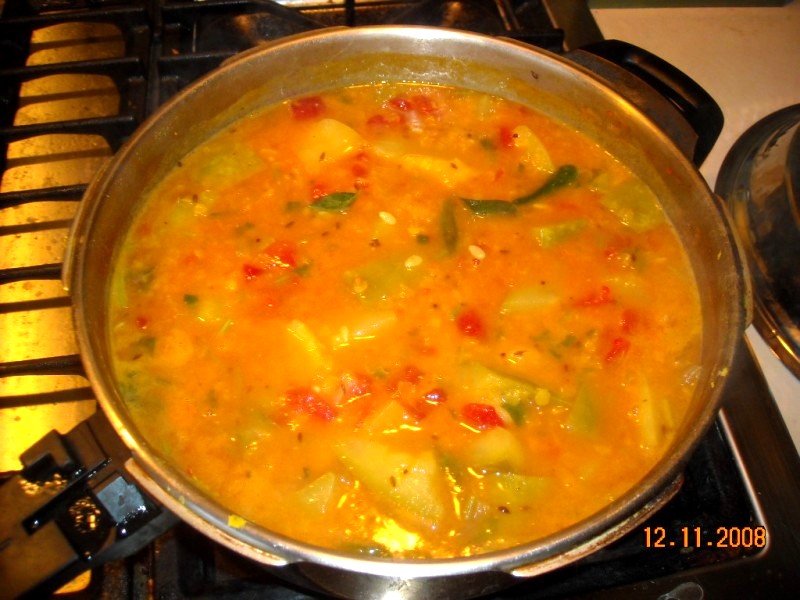
So, like I said, I made some today. Both the before and after pictures are works of art, methinks. 🙂 oh, and that other picture? Well, that’s some yummy dal. Not sambar, now. Just plain dal with some tomatoes and a fantastic tadka. Enjoy!


