Posted on Leave a comment

Chai Time: Even Better With A Danish Thriller

P812

Posted on Leave a comment

Present? What Present?

There’s no present. There’s only the immediate future and the recent past.

– George Carlin (1937-2008)

Posted on Leave a comment

Journey 2: The Mysterious Island, 2012

Lots of angry animals on an island, and a group of four who do everything possible and imaginable to negotiate the challenges of island life is what this movie is about.  Not having seen the previous one from a few years ago, I have no point of reference for comparisons and such, and yet, I have an opinion on the movie in general, as always.

All about special effects, this movie gives the Jules Verne classic the 3-D treatment, no doubt, and is very much predictable on that count.  The one small surprise is that the singing isn’t done by Vanessa Hudgens of High School Musical fame; rather, it is the Rock, aka, Dwayne Johnson who bares his pearly whites and sings away in gay abandon.

Usual big blast-off rounds out the movie, and if you’re a Journey or Jules Verne fan, you’ll be rocked by all the special effects for sure.  If you’re not, you’ll still be entertained– at least in parts.

Journey2

Posted on Leave a comment

Mike Lux: What Bible Is Santorum Reading? (Not the one I'm reading!)

When conservative Congressman Todd Akin a few months back suggested that liberalism was a “hatred of God,” I postulated that given the overwhelming support for liberal and progressive values in the Judeo-Christian Bible, perhaps he had never bothered to actually read the Bible. With Rick Santorum’s recent comment that Obama’s agenda is “Some phony theology. Oh, not a theology based on the Bible. A different theology,” I am now beginning to wonder if Santorum, Akin, and other conservatives are just reading a different Bible entirely than the one I read.


Because here’s the thing: while you can — if you really work hard to do it — find verses here and there supporting a more conservative political point of view on certain specific issues, there is simply no way to read the Bible I read and not come to the conclusion that it is overwhelmingly supportive of helping the poor, showing mercy to the weak, refraining from judging, treating others as you would treat yourself, calling on the wealthy to give their money to the poor, and all kinds of other liberal, lefty, progressive values. You would have to ignore a great deal of Genesis and Exodus, with their talk of being our brother’s keeper and bringing justice to the poor, oppressed slaves in Egypt; you would have to skip over a great many of the verses of Psalms with its poetry about justice and mercy for the poor and the widow; you would have to avoid the books of the Prophets almost entirely since so much of what they are angry about is the Israelite society’s mistreatment of poor people and immigrants in their midst. Then there is the New Testament, where between St. Paul, the relatives of Jesus, and the big guy himself, there are so many verses on these subjects that it is virtually impossible to ignore them.

In fact, as I noted in my piece about Todd Akin, Jesus talks about mercy to those in trouble in 24 verses of the Gospels, tells people not to judge in 34 verses, tells people to love and forgive even their enemies in 53 verses, tells people to love their neighbors as themselves and treat others as they would want to be treated in 19 verses, and specifically tells people to help the poor and/or spurn riches and the wealthy in 128 verses.

That is a lot of verses, 258 by my count, where Rick Santorum’s savior and George W. Bush’s favorite philosopher sounds like a tried and true, solid to the core, far-out, lefty liberal. And all those where Jesus sounds like a conservative? I couldn’t find a single one. He never once condemns abortion, even though it was very common in ancient times. He never speaks against homosexuality, even though the ancient Greeks before him and the Romans living in those times openly practiced and celebrated it. He called on the Romans and the Jewish establishment to treat the poor better, not condemn an adulteress to death, and to take the moneychangers out of the temple, but he never once asked the Romans to lower their taxes or lessen their regulations on over-burdened businesses. He never celebrated the greatness of the invisible hand of the market, and never discussed the virtues of selfishness, as conservatives today are so fond of doing.

The anti-immigrant conservative has to ignore Leviticus, which says: “Don’t mistreat any foreigners who live in your land. Instead treat them as well as you treat citizens and love them as much as you love yourself.” The pro-death penalty conservative has to ignore Jesus who told the Pharisees that he who is without sin should cast the first stone. The anti-labor conservatives have to not worry about Jesus’ brother James (the undisputed first leader of the early Christian church according to most historians) saying “Now an answer for the rich. Start crying, weep for the miseries coming to you … Laborers plowed your field and you cheated them: listen to the wages you kept back, they are calling out: realize the cries of the workers have reached the ears of the Lord.” Conservative anti-class warriors have to pretend that Jesus’ mother Mary never said about her son: “The hungry he has filled with good things, the rich sent empty away.” Conservatives like Mitt Romney who say the housing market has to hit bottom need to avoid thinking about Jesus very first sermon, where he called for a year where all debts would be forgiven. And the anti-welfare conservatives? You guys are in big trouble, as verse after verse condemns you. The one time Jesus specifically talks about how the last judgment will go down, he says, “All the nations will be assembled before him and he will separate them one from another as the shepherds separates sheep from goats.” Who gets to go to Heaven in this story? The nations and people who fed the hungry and welcomed the stranger. The ones who didn’t go straight to Hell.

These are not isolated verses: there are thousands of examples of them, and they are in every book in the Bible.

Now, look: people have every right to believe whatever they want to believe about God, Heaven and Hell, sin and salvation, the soul, and all sorts of theology. Adherents of multiple religions believe the founder of their religion ascended physically to a heaven somewhere in the sky. Fundamentalist Christians of many varieties believe that God created the world in six days about 6,000 years ago, and that there really were talking snakes and donkeys. Mormons believe the founder of their religion discovered special glasses sent by God that allowed him to read and memorize sacred texts that no one else could read. Just because I don’t personally think those things happened doesn’t mean I have anything against the faith of those who do; they are welcome to believe whatever they want to. And if you want to believe in a God who doesn’t care about the poor, loves the wealthy more than anyone else, and wants you to be selfish, feel free. But when you claim to fervently believe in the holy words of the Judeo-Christian Bible, and your political philosophy is violently opposed to most of what is actually in that Bible, I have to call you out on that. When Rick Santorum says that Obama follows a theology not based on the Bible, I have to say this: either he is not reading the same Bible I do, or he is not reading the Bible at all, because Rick Santorum’s political views are in direct, fundamental opposition to the Bible he claims to follow.

I will go so far as to say that the modern conservative faith is the direct opposite of what the Judeo-Christian Bible teaches: modern conservatives argue that everyone should take what they want and devil take the hindmost, that we are all on our own, and that if you are rich it means that a Darwinian selection process allowed you to succeed, and that you owe nothing to anyone else. Modern conservatives are far more faithful to Ayn Rand, who openly rejected Christianity because of its values of helping the poor and caring for others. Give her credit for one thing: at least she was honest. Conservatives like Romney, Santorum, and Gingrich celebrate we’re all on our own selfishness, and are happy to let the poor starve and the ill die from lack of health care, yet they proclaim their Christian holiness and denounce Obama’s theology. As Jesus would have put it: you have to take the log out of your own eye before you can take the speck out of your brother’s, you hypocrite. Mr. Santorum, if you don’t know the Bible any better than you do, you should be careful calling other people anti-Biblical.

Follow Mike Lux on Twitter: www.twitter.com/ProgressiveLux

Sotu


Posted on Leave a comment

The Origin of Photography [1569]: A Fascinating Account

Camera

What’s the history of photography?


According to Wikipedia the history of photography is made of the events that allowed the invention of a device able to record the world surrounding thanks to the properties of light, a correct although constraining definition, because i believe that is the history of PHOTOGRAPHY and not just of the camera, that include also the various photographyc genres, artistic and cultural movements, the great masters and everyone that until now gave an important contribution to this wonderful world.


Photography originate from observation, study and the application of a physic and a chemical phenomenons, both related to the behaviour and action of light.


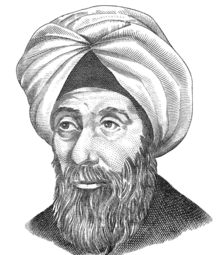
When a ray of light enter a dark place through a very small size opening, it project inside the reversed image of the external setting; this phenomenon was well-known since the ancient times, insomuch as some text place the beginning of the hitory of photography since Aristotle, one of the first that observed and made specific experiments relating the behaviour of light rays, and he observed that the light passing through a small hole, projected a circular image. The arabian scholar Alhazen Ibn Al-Haitham came, (before 1039, to the same conclusions, defining the box where all the images reproduced, “camera obscura“).


Right after the year 1000 the phenomenon was studied by many arabian scholars and in the second half ofthe 13th century from the english physicist Roger Bacon. In the 14th century, before the citizen of Messina Francesco Maurolico (Photismi de lumine et umbra) and later Leonardo da Vinci (in the collection of writings known as Codex Atlanticus) explain how the camera obscura and works and at the same time how the eyes works.


The image down was realized by Leonardo da Vinci during his studies on the light behaviour and the functioning of the human eye.

In the same period started the studies oriented to the application on the camera obscura.


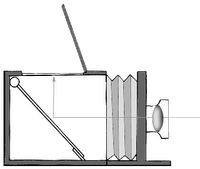
The latter is realized in various forms, the most common is a box made of wood, provided on a side with a tiny hole made on a thin metal sheet (pinhole), that allow the entrance of light that on the opposite side have a ground glass used to observe the image.


Camera Obscura become an instrument: during the renaissance it’s used to project, on walls or canvases, the traces used to realize drawings or paitings.


It’s used by a painter such as Raffaello and in the following centuries will be used by other artists (Canaletto, Vermeer) and is generally used by those who are in need to reproduce landscapes and perspectives in the possible most faithful way.
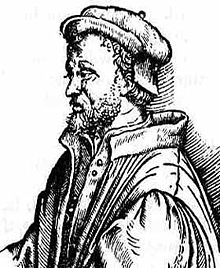
 

Girolamo Cardano

The italian scientist and philosopher Girolamo Càrdano towards the half of 1500 apply to the camera obscua a biconvex lens instead of the pinhole in order to concentrate the light rays obtaining in that way an higher clearness and quality of the image.


After few years (1569) the venetian Daniele Barbaro, Professor at the university of padova, shows that the application of an aperture with a smaller size respect the one of the lens improves tha quality of the image.


Daniele Barbaro

Speaking of lenses we shouldremember that in 1609 Galiloo Galilei project and build his first telescope.


In 1646 in Amsterdam, Athanasius Kircher build a giant camera obscura for drawing.


Its size is so big that the artist and his assistant can work on the inside.


Kirker realize that the camera obscura phenomenon can work in the opposite way, that is projecting outside and he formulate the idea of the so called “magic lantern”. an image projector very similar to the future film projector, precursor of the slide projector.

Athanasius Kircher – Magic Lantern
A further improvement wasthe work of Kaspar Schott, in 1657, that build a camera obscura made of two sliding drawers one inside the other that allowed to move the lens in a way that you could change the distance between the lens and the projection plane and then to focus the image.

This system will be used untile the bith of photography, and it will be outdated only after invention of the bellow in the second half of 1800.


Let’s consider now the chemical phenomenon that we mentioned at the beginning. It was well-known to the alchemists of the late middle age that some substance blackened orchanged colour under some circumstances.


The phenomenon was difficult to handle because the conditions when it happened wasn’t clear.


During the XVII century, the famous irish scientist Robert Boyle considered that the blackening that the silver chlorate was subject to, wasdeterminedby the exposition to air and no to light.


The first that used the experimental method to prove that the blackening of certain substance was due of their photosensitivety was the german chemist Johann Heinrich Schulze, Professor in anatomy at the Altdorf university, during some experiments with calcium carbonate, aqua regia, nitric acid and silver, discovered that the resulting compound, basically silver chloride,reacted to light.


He noticed that the substance didn’t change if exposed to the fire light (Orthochromatism opposed to Pancromatism), but it became dark red if illuminated by sunlight, exactly like the most of films and black & withe papers used inthe first half of 1900 based on the unmodified silver halide.


In 1725 he redid the experiment filling a glass bottle that, after the exposure to light, darkened only on the lit side. To the purpose of verify and confirm the result he apply to the bottle paper silouetthes or leaves, observing that, when removed, on the compound remained their brighter shape.


The shape of these silouetthes was naturally temporary because the exposure a light caused in a brief time the darkening of the bright parts.


He called this substance scotophorus, darkness bringer. Once published, Schulze’s sudies caused turmoil in the in the scientific research world.


Some years later, the experiments of the italian physicist Giovanni Battista Beccaria proved permanently that the blackening phenomenon was related to the substances that contained salts of silver and then that is the latter that is tipified by the property of being photosensitive.


Furthermore he wrote an essay on how to use a camera obscura to ease drawing. The image of the persons (out of the camera obscura) was projected on a canvas inside with the painter(the camera obscura was more like a bigroom in this case) that tried to copy it.


Thei method is very similar to the one used in the animation with the rotoscoping technique used at the beginning of the XXth century. The process to use the camera obscura scared the people and Giovanni Battista had to give up the idea after being arrestad and put under trial for witchcraft.


An attempt to apply in a practical way the photosensitivety phenomenon to obtain images was effectuated by Thomas Wedgwood, son of Josiah Wedgwood and heir of the hoonimous dinasty oh british potters.
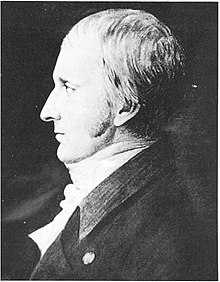
 

Thomas Wedgwood

Thomas Wedgwood


Student at the Edinburgh university on the end of the XVIIIth century makes serveral experiments using silver nitrate to sensitize some paper sheets and obtain on them the silouetthes of object leaned on them, in a similar way of what schulze did.


He realize light prints on paper or leather bu they was visibile only if lighte by a candle’s flame because the a brighter light make them inexorably disappear.


He is forced to stop his experiment cause of his bad healt condition tha will bring him to death in 1805 at just 34 years.


His friend Sir Humphry Davy describe his results obtained describing the in the essay Method of Copying Paintings upon Glass published on “Journal of the Royal Institution of Great Britain”.


In this text is specified that Wegwood didn’t find a way to stop the blackening process , that is a way to desensistize the paper parts never reached by light, even though a recent exam of some documents exchanged between Wedgwood and JamesWatt brought someon to think that it happened.


“it was going to occur the 7 april 2008 at sotheby’s but the auction was posponed. It was a paper attributed to Thomas Wedgwood with an impressed tree leaf. Until now it was considered a Talbot’s “photogenic drawing” but a little W impressed in a corner made change his mind to the photography historian Larry Schaaf. We might have got to move the production of the first photography of about 20 years.”


In the the same years, between the XVIII and the XIX century will start the experiments of the french Joseph-Nicéphore Niépce, that will have a crucial importance.

Joseph Nicéphore Niépce is attributed to the first photo of all times.


Posted on Leave a comment

On This Day: February 22

Updated February 21, 2012, 1:28 pm

NYT Front Page

On Feb. 22, 1980, in a stunning upset, the United States Olympic hockey team defeated the Soviets at Lake Placid, N.Y., 4-to-3. (The U.S. team went on to win the gold medal.)

Go to article »

On Feb. 22, 1892, Edna St. Vincent Millay, the Pulitzer Prize-winning poet who personified romantic rebellion, was born. Following her death on Oct. 19, 1950, her obituary appeared in The Times.

Go to obituary » | Other birthdays »


On This Date

By The Associated Press

1819 Spain ceded Florida to the United States.
1862 Jefferson Davis was inaugurated as president of the Confederacy.
1865 Tennessee adopted a new constitution abolishing slavery.
1879 Frank Winfield Woolworth opened a five-cent store in Utica, N.Y.
1924 Calvin Coolidge delivered the first presidential radio broadcast from the White House.
1932 Sen. Edward M. Kennedy, D-Mass., was born in Boston, the youngest child of Joseph P. and Rose Kennedy.
1935 It became illegal for airplanes to fly over the White House.
1959 The inaugural Daytona 500 race was held in Daytona Beach, Fla.
1980 The U.S. hockey team beat the Soviets 4-3 In a stunning upset at the Winter Olympics in Lake Placid, N.Y.
2001 A U.N. war crimes tribunal convicted three Bosnian Serbs on charges of rape and torture in the first case of wartime sexual enslavement to go before an international court.
2006 Insurgents destroyed the golden dome of one of Iraq’s holiest Shiite shrines, the Askariya mosque in Samarra, setting off a spasm of sectarian violence.
2011 A magnitude-6.1 earthquake in Christchurch, New Zealand, killed 184 people.
2011 Somali pirates shot to death four Americans taken hostage on their yacht several hundred miles south of Oman.

Current Birthdays

By The Associated Press

Drew Barrymore, Actress

Actress Drew Barrymore turns 37 years old today.

AP Photo/Evan Agostini

Kyle MacLachlan, Actor

Actor Kyle MacLachlan turns 53 years old today.

AP Photo/Evan Agostini

1918 Don Pardo, TV announcer (“Saturday Night Live”), turns 94
1944 Jonathan Demme, Director, turns 68
1950 Julius Erving, Basketball Hall of Famer, turns 62
1952 Bill Frist, Former Senate majority leader, turns 60
1955 David Axelrod, Senior White House adviser, turns 57
1963 Vijay Singh, Golfer, turns 49
1965 Pat Lafontaine, Hockey Hall of Famer, turns 47
1966 Rachel Dratch, Actress, comedian (“Saturday Night Live”), turns 46
1968 Jeri Ryan, Actress (“Boston Public”), turns 44
1972 Michael Chang, Tennis Hall of Famer, turns 40
1977 James Blunt, Singer, turns 35


Historic Birthdays

Edna St. Vincent Millay 2/22/1892 – 10/19/1950 American poet and dramatist.Go to obituary »
58 Charles VII 2/22/1403 – 7/22/1461
King of France from 1422 to 1461
67 George Washington 2/22/1732 – 12/14/1799
American general and first president of U.S.
82 Rembrandt Peale 2/22/1778 – 10/3/1860
American painter, writer and portraitist
72 Arthur Schopenhauer 2/22/1788 – 9/21/1860
German philosopher
72 James Russell Lowell 2/22/1819 – 8/12/1891
American poet, critic, essayist and diplomat
73 August Bebel 2/22/1840 – 8/13/1913
German co-founder of the Social Democratic Party
77 Bill Klem 2/22/1874 – 9/16/1951
American National League baseball umpire
90 David Dubinsky 2/22/1892 – 9/17/1982
Russian-bn. American labor leader
83 Luis Bunuel 2/22/1900 – 7/29/1983
Spanish director and filmmaker
91 Sean O’Faolain 2/22/1900 – 4/20/1991
Irish short-story writer and teacher
80 Peter Hurd 2/22/1904 – 7/9/1984
American painter, printmaker and illustrator
73 Giulietta Masina 2/22/1921 – 3/23/1994
Italian motion-picture actress


Posted on 1 Comment

316/365/01

P807