
via thekitchn.com
I love tea as much as I love coffee– and maybe just a little bit more! My current favorite in the office is Hot Cinnamon Spice.
Creating, collecting, and sharing thoughts and ideas. And learning along the way.
I love tea as much as I love coffee– and maybe just a little bit more! My current favorite in the office is Hot Cinnamon Spice.

Lovely! I’ve had the pleasure of seeing both the Bay Bridge and the Golden Gate Bridge in San Francisco four years ago this time of year!
But if he is lauded overseas, Mr. Singh is now under attack at home, as critics blame his administration for indecision and inaction. His government is besieged by corruption scandals, runaway inflation and bickering among senior ministers. Amid the clamor, Mr. Singh has often seemed silent or aloof, even as his political enemies have portrayed him as the weak captain of a rudderless administration.
The loud criticism of Mr. Singh, who sits atop the coalition government led by the Indian National Congress Party, is partly the white noise of India’s raucous democracy, and partly a reprise of old complaints.
But the public perception of disarray is one reason the prime minister made a show of reshuffling his cabinet on Wednesday afternoon.
In a nationally televised ceremony from India’s presidential palace, the new members of Mr. Singh’s cabinet were sworn into office. Changes were made in several ministries plagued with poor performance or scandals during the past year, including those responsible for aviation, roads, sports, petroleum and coal. But the major figures overseeing foreign affairs, finance, home security and defense remained in place.
Many analysts say Mr. Singh must recharge his administration to tackle major issues like food security, power supply and infrastructure, as well as to push through reforms on land and governance. More than that, they say, he must seize the moment to address larger, systemic failures in governing that foster corruption and could eventually undermine India’s aspirations to become a global power.
Yet even as Mr. Singh reshuffled his lineup, most ministers were moved rather than fired. M.S. Gill, whose performance was sharply criticized during the staging of the Commonwealth Games, was downgraded to a lesser ministry overseeing statistics. Kamal Nath, who was regarded as ineffective at the critical roads ministry, was moved to the ministry of urban development.
For now, India’s economy is sizzling, growing at roughly 9 percent a year. Many economists are forecasting a long boom that, if handled properly, could transform the nation. Many Indian entrepreneurs have learned to thrive despite governmental dysfunction, but few analysts believe India can thrive long term if the government maintains the status quo.
“There are so many uncertainties over the next four or five years that if you don’t fix things while the going is good, it is going to be that much harder, later,” said Pratap Bhanu Mehta, president of the Center for Policy Research, a leading independent research institute in New Delhi. “Given the historic opportunity that India has, they are frittering away precious time.”
Mr. Singh, now 78, usually floats above the rancor of India’s daily politics. Trained as an economist, he is considered a father of the economic reforms credited for setting off India’s current boom. As finance minister, beginning in 1991, he dismantled socialist-era restraints and oversaw India’s transition to a more open, market-based economy. By 2004, after Sonia Gandhi had guided the Congress Party back to power, she made Mr. Singh her surprise choice for prime minister.
Indeed, Mr. Singh’s critics have long disparaged him as a caretaker prime minister beholden to Mrs. Gandhi, the Congress Party president, and to her son, Rahul Gandhi, the party’s heir apparent as prime minister. Yet Mr. Singh proved otherwise, especially when Congress Party leaders and coalition allies wavered on a landmark civilian nuclear agreement with the United States. Mr. Singh threatened to resign if the Congress Party did not back him on the deal — which it promptly did.
In the 2009 elections, opposition leaders in the Bharatiya Janata Party, or B.J.P., depicted Mr. Singh as India’s weakest prime minister, but voters re-elected his Congress-led United Progressive Alliance government. When the new government took office, public expectations were high.
Now, 20 months later, the Congress Party has suffered setbacks in elections in the state of Bihar and is wounded by corruption scandals linked to the Commonwealth Games, the government’s allotment of 2G telecommunications spectrum and other cases of official malfeasance.
Mr. Singh must no doubt operate at the mercy of the imperfections of India’s coalition politics. But his cabinet has witnessed periodic infighting, while the prime minister himself has seemed slow to respond to certain crises, his critics say.
When Kashmir erupted in violence and demonstrations last summer, Mr. Singh waited for months before strongly intervening. And though he has not been personally linked to any scandals, he has been criticized for his inability, or unwillingness, to crack the whip on corruption and push through reforms.
“In spite of a clean personal image,” said Nirmala Sitharaman, a B.J.P. spokeswoman, “he is heading a government that is responsible for unbelievable amounts of treasury loss.”
Sanjaya Baru, a former spokesman for the prime minister, said the scandals had come as Mr. Singh’s political influence already seemed diminished. He was forced to make a public reversal after making an overture to Pakistan that apparently exceeded the dictates of other Congress Party leaders. His signature achievement — the nuclear deal — was passed with a liability clause that may prevent many foreign nuclear suppliers from building power plants in India.


You may think of the famed French brandy as a sipping spirit, but cognac has a long mixological history. In fact, it was an extremely popular ingredient in the early 1800s, when the cocktail was born. Since its flavor combines deliciously with fruits and juices, cognac is the backbone of a wide range of both classic and modern drinks. Here are some of our favorites.
I might try that Apple Toddy myself sometime!

Another old post dug out to be published here. First published on Thursday, December 11, 2008.
I cooked some today myself. And so fascinating did I find the lovely bright purple coloring of the small fruit (they’re technically a fruit, you see!), that I couldn’t help but pull out my camera and take a picture!
BTW, these are in water. That’s how my mother taught me to cut and handle eggplant. Always put them into water so they won’t oxidize and turn a dirty grayish-brownish hue.
 In India, we get the small variety with the thorns on the stem. These are generally trimmed off and slit right from the top of the stem into halves or fourths without going all the way down the entire egglpant, thereby leaving each one still whole, but with several slits that absorb all the masalas while cooking.
Well, I usually cut them up like that, but today, I decided to take my knife all the way down the length of each one and made nice long slices. Soaking in this lovely stainless-steel tray (new one that I brought back from India this past summer!), they look like the perfect model for a lovely still-life drawing!
I think it was my grandmother who used to say that the brinjal is the king of the vegetables– hmm… I don’t know if I’d argue with her because I gotta say this is one versatile and yummy and a good-for-you veggie that can be made in a multitude of ways.
In Hyderabad, the Bagara Baingan is the traditional sidedish that goes with Biryani. The small ones are used for this: smothered in the most decadent gravy of khuskhus and peanuts and all kinds of garam masala, the baingan look almost too good to eat! But the baingan can also be made in a variety of other more humble ways: I made a simple subzi that has a base of onions, ginger, garlic, tomatoes and some basic masala. Ocassionally, I’ll toss in some potatoes as well, but I didn’t have any today. There are as many themes and variations to making the eggplant as there are differences by region and customs. In the South, it is routinely added to sambar and made into a variety of colombos. 🙂 And beyond India, it is equally popular in other parts of the world as well: in the Middle East, Baba Ghanouj has as its key ingredient– you guessed it: the eggplant. In Italy, Greece, Spain and the rest of the Mediterranean, the eggplant is glorified in all kinds of casseroles and doused with cheese and breadcrumbs and is boiled and baked and even deep-fried.
Well, very interesting it is that the eggplant is native to India. So much India has given to the world! How resourceful its people are to cultivate something good, and then to offer it to the many foreigners who came to its shores so as to allow them to take the seeds back to their own native lands and cultivate it for themselves.
Well, in case you wish to learn more about this wonderful fruit/vegetable, go to: http://en.wikipedia.org/wiki/Eggplant
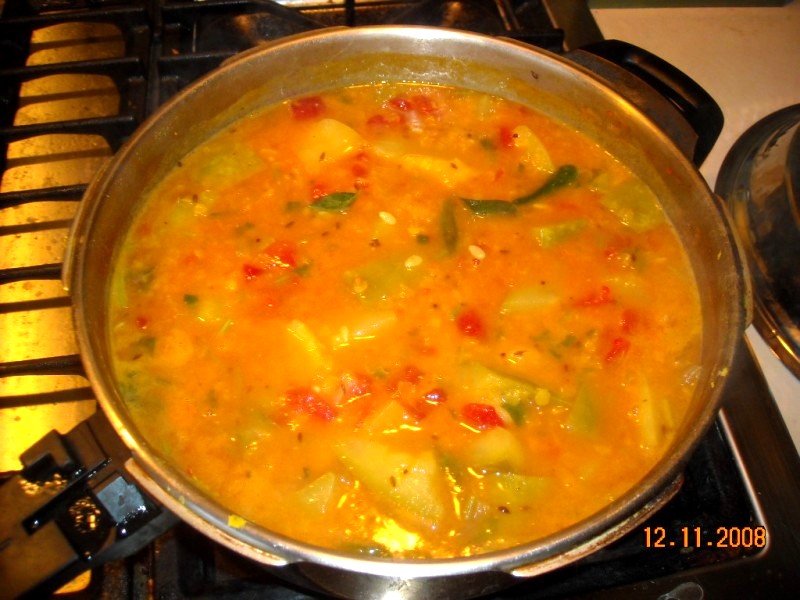
So, like I said, I made some today. Both the before and after pictures are works of art, methinks. 🙂 oh, and that other picture? Well, that’s some yummy dal. Not sambar, now. Just plain dal with some tomatoes and a fantastic tadka. Enjoy!

1. Walking (1963)
after the painting by Charles Alston
You tell me, knees are important, you kiss
your elders’ knees in utmost reverence.
The knees in this painting are what send the people forward.
Once progress felt real and inevitable,
as sure as the taste of licorice or lemons.
The painting was made after marching
in Birmingham, walking
into a light both brilliant and unseen.
3. 1968
The city burns. We have to stay at home,
TV always interrupted with fire or helicopters.
Men who have tweedled my cheeks once or twice
join the serial dead.
Yesterday I went downtown with Mom.
What a pretty little girl, said the tourists, who were white.
My shoes were patent leather, all shiny, and black.
My father is away saving the world for Negroes,
I wanted to say.
Mostly I go to school or watch television
with my mother and brother, my father often gone.
He makes the world a better place for Negroes.
The year is nineteen-sixty-eight.
Elizabeth AlexanderElizabeth Alexander was born in Harlem, raised in Washington, D.C., and attended Yale University, where she now teaches African American Studies. She is the author of six books of poems, including most recently, “Crave Radiance: New and Selected Poems 1990-2010.” On Jan. 20, 2009, Alexander became just the fourth poet to recite an original poem at a U.S. presidential inauguration. Here is a recent conversation with her on Art Beat. Also, watch Alexander’s 2009 conversation with Jeffrey Brown.

Espresso and milk / At one-seventy degrees / You can calm my nerves!

This was my cappucino at Sweetwaters Cafe last Sunday.


