Creating, collecting, and sharing thoughts and ideas. And learning along the way.
Updated March 14, 2012, 2:28 pm
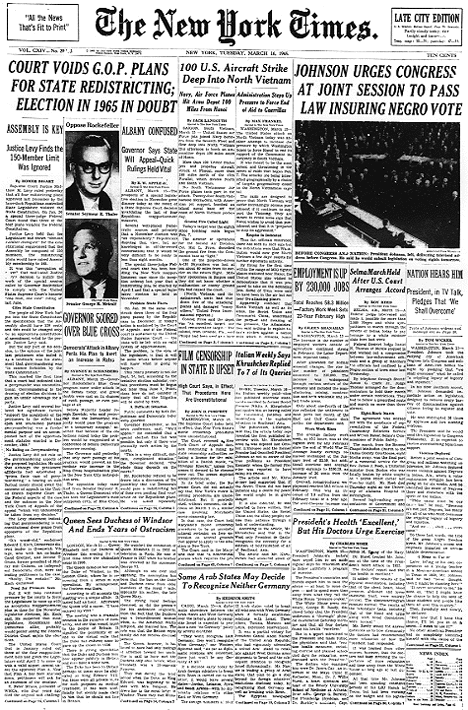
On March 15, 1965, addressing a joint session of Congress, President Johnson called for new legislation to guarantee every American’s right to vote.
On March 15, 1858, Liberty Hyde Bailey, a botanist who traveled around the world to collect and classify thousands of plants, was born. Following his death on Dec. 25, 1954, his obituary appeared in The Times.
Go to obituary » | Other birthdays »
On This Date
By The Associated Press
44 B.C. Roman dictator Julius Caesar was assassinated by a group of nobles that included Brutus and Cassius. 1493 Christopher Columbus returned to Spain, concluding his first voyage to the Western Hemisphere. 1820 Maine became the 23rd state. 1913 President Woodrow Wilson held the first open presidential news conference. 1919 The American Legion was founded in Paris. 1956 The Lerner and Loewe musical “My Fair Lady” opened on Broadway. 1964 Actress Elizabeth Taylor and actor Richard Burton were married; it was her fifth marriage, his second. 1965 Addressing a joint session of Congress, President Lyndon B. Johnson called for new legislation to guarantee every American’s right to vote. 1972 “The Godfather,” Francis Ford Coppola’s epic gangster movie based on the Mario Puzo novel and starring Marlon Brando and Al Pacino, premiered in New York. 1975 Greek shipping magnate Aristotle Onassis, the husband of former first lady Jacqueline Kennedy, died at age 69. 1985 The first Internet domain name, symbolics.com, was registered by the Symbolics Computer Corp. of Massachusetts. 2003 Hu Jintao was chosen to replace Jiang Zemin as the president of China. 2003 The World Health Organization issued a worldwide health alert for the respiratory illness SARS (severe acute respiratory syndrome). Current Birthdays
By The Associated Press
Supreme Court Justice Ruth Bader Ginsburg turns 79 years old today.
AP Photo/Pablo Martinez Monsivais
Boston Red Sox first baseman Kevin Youkilis turns 33 years old today.
AP Photo/Charles Krupa
1932 Alan L. Bean, Astronaut, turns 80 1935 Judd Hirsch, Actor (“Taxi”), turns 77 1940 Phil Lesh, Rock musician (Grateful Dead), turns 72 1941 Mike Love, Rock singer (The Beach Boys), turns 71 1943 Sly Stone, Rock singer, musician, turns 69 1947 Ry Cooder, Rock musician, turns 65 1955 Dee Snider, Rock singer (Twisted Sister), turns 57 1957 Park Overall, Actress (“Empty Nest”), turns 55 1961 Fabio, Model, turns 51 1962 Terence Trent D’Arby, R&B singer, turns 50 1963 Bret Michaels, Rock singer (Poison), turns 49 1964 Rockwell, R&B singer, turns 48 1968 Mark McGrath, Rock singer (Sugar Ray), turns 44 1969 Kim Raver, Actress (“24”), turns 43 1972 Mike Tomlin, Football coach, turns 40 1975 Eva Longoria, Actress (“Desperate Housewives”), turns 37 1975 will.i.am, Rapper, musician (Black Eyed Peas), turns 37 1981 Young Buck, Rapper, turns 31
Historic Birthdays
Liberty Hyde Bailey 3/15/1858 – 12/25/1954 American botanist and writer.Go to obituary »
58 Franciscus Sylvius 3/15/1614 – 11/15/1672
German physician, physiologist and chemist78 Andrew Jackson 3/15/1767 – 6/8/1845
7th president of the United States (1829-37)69 William Lamb Melbourne 3/15/1779 – 11/24/1848
English prime minister and adviser to Queen Victoria83 Jules Chevalier 3/15/1824 – 10/21/1907
French priest, author and founder of the Sacred Heart Missionaries63 Emil von Behring 3/15/1854 – 3/31/1917
German Nobel Prize-winning bacteriologist68 Christian Michelsen 3/15/1857 – 6/28/1925
Norwegian prime minister; separated Norway from Sweden in 190577 Harold Ickes 3/15/1874 – 2/3/1952
American statesman77 Henri Saint Cyr 3/15/1902 – 7/27/1979
Swedish equestrian; winner of two Olympic gold medals67 Harry James 3/15/1916 – 7/5/1983
American trumpeter and bandleader
MORNING
“I am a stranger with thee.”
Psalm 39:12Yes, O Lord, with thee, but not to thee. All my natural alienation from thee, thy grace has effectually removed; and now, in fellowship with thyself, I walk through this sinful world as a pilgrim in a foreign country. Thou art a stranger in thine own world. Man forgets thee, dishonours thee, sets up new laws and alien customs, and knows thee not. When thy dear Son came unto his own, his own received him not. He was in the world, and the world was made by him, and the world knew him not. Never was foreigner so speckled a bird among the denizens of any land as thy beloved Son among his mother’s brethren. It is no marvel, then, if I who live the life of Jesus, should be unknown and a stranger here below. Lord, I would not be a citizen where Jesus was an alien. His pierced hand has loosened the cords which once bound my soul to earth, and now I find myself a stranger in the land. My speech seems to these Babylonians among whom I dwell an outlandish tongue, my manners are singular, and my actions are strange. A Tartar would be more at home in Cheapside than I could ever be in the haunts of sinners. But here is the sweetness of my lot: I am a stranger with thee. Thou art my fellow-sufferer, my fellow-pilgrim. Oh, what joy to wander in such blessed society! My heart burns within me by the way when thou dost speak to me, and though I be a sojourner, I am far more blest than those who sit on thrones, and far more at home than those who dwell in their ceiled houses.
“To me remains nor place, nor time:
My country is in every clime;
I can be calm and free from care
On any shore, since God is there.
While place we seek, or place we shun,
The soul finds happiness in none:
But with a God to guide our way,
‘Tis equal joy to go or stay.”
EVENING
“Keep back thy servant also from presumptuous sins.”
Psalm 19:13Such was the prayer of the “man after God’s own heart.” Did holy David need to pray thus? How needful, then, must such a prayer be for us babes in grace! It is as if he said, “Keep me back, or I shall rush headlong over the precipice of sin.” Our evil nature, like an ill-tempered horse, is apt to run away. May the grace of God put the bridle upon it, and hold it in, that it rush not into mischief. What might not the best of us do if it were not for the checks which the Lord sets upon us both in providence and in grace! The psalmist’s prayer is directed against the worst form of sin–that which is done with deliberation and wilfulness. Even the holiest need to be “kept back” from the vilest transgressions. It is a solemn thing to find the apostle Paul warning saints against the most loathsome sins. “Mortify therefore your members which are upon the earth; fornication, uncleanness, inordinate affection, evil concupiscence, and covetousness, which is idolatry.” What! do saints want warning against such sins as these? Yes, they do. The whitest robes, unless their purity be preserved by divine grace, will be defiled by the blackest spots. Experienced Christian, boast not in your experience; you will trip yet if you look away from him who is able to keep you from falling. Ye whose love is fervent, whose faith is constant, whose hopes are bright, say not, “We shall never sin,” but rather cry, “Lead us not into temptation.” There is enough tinder in the heart of the best of men to light a fire that shall burn to the lowest hell, unless God shall quench the sparks as they fall. Who would have dreamed that righteous Lot could be found drunken, and committing uncleanness? Hazael said, “Is thy servant a dog, that he should do this thing?” and we are very apt to use the same self-righteous question. May infinite wisdom cure us of the madness of self-confidence.


It’s a myth that the U.S. doesn’t make anything anymore. It’s a myth that we don’t export anything to the rest of the world.
Yes, we import more than we export. Our trade deficit last year was $558 billion
But we export a lot. Last year, U.S. exports were worth $2.1 trillion. Which raises a simple question: $2.1 trillion worth of what?
Mostly goods. Also, services:

Source: Bureau of Economic Analysis
Here’s a closer look at our goods exports in 2011. The two biggest categories — industrial supplies and capital goods — account for about $500 billion a piece.

Source: Bureau of Economic Analysis
Here’s a breakdown of our services exports:

Source: Bureau of Economic Analysis
Royalties and licensing includes money people pay to use American software, and to distribute movies and TV shows. It also includes wonkier stuff, like payments to use patents on industrial processes.
One interesting note about travel: When foreign tourists come to the U.S. and buy stuff, it counts as exports. This makes sense if you think about how the money flows. It’s money coming in from other countries, and being used to buy services produced in the U.S.
So who’s buying all these goods and services? Here’s the top five:

Source: Bureau of Economic Analysis
That Canada and Mexico hold the top spots is a reminder that, even in this globalized world, proximity still matters. (Also: NAFTA.)
And here’s the top goods we’re selling to each of the top five. It’s striking how varied this list is — from soybeans (China) to auto parts (Canada) to gold (U.K.).

Source: U.S. Census Bureau
Correction: Due to an editing error, an earlier version of this post had an incorrect figure for the U.S. trade deficit.

 Borwein lecturing at University of Technology Sydney on March 14, 2011
Why, might you ask, should anyone want to celebrate a mathematical constant which allows you to calculate the area inside a circle?
As unlikely as it may seem, the number pi, or 3.14159… has been crucial to the development of modern life. As far back as the ancient civilizations of Babylon and Egypt, people needed approximations of pi to deal with the flooding of the Tigris, Euphrates and Nile rivers, for astronomy, and for surveying and building ziggurats and pyramids. The ancient Greeks were the first to study pi for its own mathematical sake.
Today, 4,000 years after people first discovered how useful pi could be, we are about to celebrate International Pi Day. The first time a day was dedicated to pi was on March 14, 1989 at the Exploratorium, a museum of science, art and human perception in San Francisco. The idea was the brainchild of Larry Shaw, a physicist at the center. (See picture of Larry Shaw, “Prince of Pi,” at right.)
Since then, this museum and many others, as well as universities, schools and individuals have celebrated Pi Day by performing pi-related activities; some serious and some less so, such as creating pi puns; baking, throwing and eating pies; and singing pi songs. You can check out this year’s bash at the Exploratorium here.
The date is derived from the first three digits of pi — 3.14 — using American dating order, just as September 11 is 9/11. And 2015 is going to be a big year for pi since we will celebrate 3.14 15 (correct to 4 places)
At first, Pi Day was a gimmick and a good joke, but now it is a big deal. Many North American and UK schools use it to spark interest in maths and science projects (for example, learning how the Greeks or Arabs did arithmetic; studying famous scientists like Gauss, Newton or Archimedes who worked on pi; or perhaps calculating the volumes of real pies before eating them).
What is Pi?
Pi is represented by the Greek letter π, and it is the most important numerical constant in mathematics. You can compute the area of a circle of radius r, using πr2. The perimeter of this circle has length 2πr.
Without pi there is no theory of motion and no understanding of geometry. For instance, the volume of a sphere of radius r is 4/3πr3 and that of a cylinder of height h is πr2h.
Pi occurs in important fields of applied mathematics such as Fourier analysis and image reconstruction. It is used throughout engineering, science and medicine and is studied for its own sake in number theory.
Pi goes global
Public interest in pi came to a head in 2009 when the U.S. House of Representatives formally declared March 14 National Pi Day, in House Resolution number 224. The Bill grandly begins:
“Whereas the Greek letter (pi) is the symbol for the ratio of the circumference of a circle to its diameter… ”
After many more “whereases,” it resolves…
“That the House of Representatives (1) supports the designation of a Pi Day and its celebration around the world.”
The bill urges schools and educators to help learn about pi and generally engage students in the study of mathematics.
The growing interest in pi has seen it become firmly established in popular culture. Pi has been featured in such TV shows as The Simpsons and Star Trek, as the title of a Kate Bush song, in the movies The Matrix, and Pi; and in the 2001 novel Life of Pi by Yann Martel. Oscar-winning director Ang Lee has just completed a 3D movie version.
Things you can try
Pi has even inspired the invention of a new literary form called ‘piems.’ The challenge is to write a poem where the length of each word is the same as the number in the pi sequence.
For example, the first eight decimal places of pi can be recalled with the phrase: “How I need a drink, alcoholic of course” (to represent 3.1415926). Some piems are thousands of words in length. And there is money in piems. A student won 250 euro for a 2011 piem in Spanish.
If you’re better with numbers than words, some folks prefer to memorise pi for themselves. The current Guinness World Record for remembering pi is well in excess of 60,000 digits. If you want to give it a try, memorisers typically add 10 or 15 digits a day to their total.
What next?
Meanwhile, the world’s computational mathematicians continue to outdo each other, calculating pi to ever more decimal and hexadecimal (base 16) places. The current world record is ten trillion (10,000,000,000,000) decimal digits. It was set in October last year by Japanese systems engineer Shigeru Kondo, using an $18,000 homemade computer running software developed by American grad student Alex Yee.
Irrational attraction
But just as climbers still climb Mount Everest, this is certainly not the end. Within the next ten years a quadrillion digits will probably have been computed.
What makes things really interesting is that pi is an irrational number, so its digits never terminate or repeat. While it never runs dry, we cannot even prove that the decimal expansion of pi has infinitely many sevens, let alone that it is normal, although I would bet it is (in other words that it has equally many ones, twos, threes, etc). My co-workers (including Alex Yee) and I have just completed a research paper analyzing roughly 16 trillion bits (binary digits) and have concluded it is almost certainly normal.
When we draw a picture, pi seems very random. The figure to the left shows a ‘random walk’ on the first two billion binary digits of pi.We convert ’01’ to ‘left,’ ’10’ to ‘right,’ ’11’ to up and ’00’ to down (or something like that) and we have a turtle graphic.
The picture to the right does the same thing for a pseudo-random string of bits. In each case we change colors as we walk and march through the spectrum — from red through indigo and violet and back to red.
If you go to the web you can explore a ten billion step gigapan movie-walk on pi.
While it is very likely we will learn nothing really new mathematically about pi from computations to come, we just may discover something truly startling. That was part of the punch line in astronomer Carl Sagan’s novel Contact, when he suggested that alien life forms encoded messages to the human race in the numerical value of pi.Stay tuned!

One of the joys of reading books set in another time or another place is the foreignness of the language, even if that language is English. Locutions unknown in your backyard wing through the pages like unfamiliar birds. If they look different than the words you know, it’s because they’ve evolved to fit another linguistic ecosystem: that’s how people there talk, with the words necessary to describe their lives.
Take Laura Ingalls Wilder’s classic children’s novel Little House in the Big Woods. First published in 1932 and set in rural Wisconsin around 1870, it begins a series about Laura and her family that has gripped generations of children. Much of its appeal lies in Wilder’s depictions of a domestic life her modern readers will never know: how the family handles bears, which parts of a slaughtered hog make good toys, how women arrange their hair for a dance at maple sugaring time. That dance is capped by a memorable moment:
“Suddenly Grandma stopped laughing. She turned and ran as fast as she could into the kitchen. The fiddle had stopped playing … everybody was still for a minute, when Grandma looked like that.
“Then she came to the door between the kitchen and the big room, and said:
“‘The syrup is waxing. Come and help yourselves.'”
At this, everyone races outside, fills plates with snow and comes back for Grandma to pour hot maple syrup onto the snow, where it turns into soft candy. Gloriously, the children are allowed to “eat all they wanted, for maple syrup never hurt anybody.”
But what is this “waxing” — a word powerful enough to bring an entire dance party to a halt? One-hundred-forty years later, in a world where a night’s entertainment rarely depends on the cooking stages of maple syrup, it’s a term few of us recognize.
Fortunately, there is a guidebook: the lexicographical analogue of Audubon’s Birds of America. I’m referring to the Dictionary of American Regional English, a 50-year project to collect English as it has been spoken in various parts of this country. The fifth volume, covering Sl through Z, was just published this month. If you’re the kind of person who is delighted to stumble across one strange new word in a book, you may find reading this enormous volume to be an almost excessive pleasure.
 Enlarge iStockphoto.com
The “snow parties” of the last century popularized “waxing,” the pouring of maple syrup on snow to produce a chewy candy.
 iStockphoto.com
The “snow parties” of the last century popularized “waxing,” the pouring of maple syrup on snow to produce a chewy candy.
Flip open Volume V, and there it is: wax, or maple sugar wax, or wax on snow, used largely in the northeast, but apparently extending as far west into maple sugaring country as Wisconsin. The dictionary includes a 1954 quotation suggesting that festivities similar to the Ingalls family’s continued into the 20th century: “Now and then ‘snow parties’ do take place these days, with singing and dancing in the kitchen by the stove and the chief point of the party, eating ‘wax on snow.'”
Like the Oxford English Dictionary, this series builds a history of each word through chronologically ordered quotations, many taken directly from field interviews with local “informants.” For this reason, the Dictionary is a book you can actually sit down and read — not just for colorful words and quotations, but also for a tour of actions, objects, creatures and categories central to far-off or vanished pockets of American life.
Some entries point to regionally distinctive obsessions. It makes sense that seafaring inhabitants of the New England island of Nantucket would need a word, slatchy, for a sky that mingles stormy weather with patches of blue, or that in the South, where sweetened iced tea flows like water, the peculiar alternative must be distinguished as unsweet tea.
But more of the terms seem simply to reflect our past. It’s striking to note all the words for the diverse things people used to invent and make — games (three-kitten-mitten), food (soft pie), and so on — which have now been replaced by nationally marketed, off-the-rack products (Angry Birds, Oreos). Equally notable are the local words for birds, fish, animals and plants whose names, in these days of urbanization and supermarket chains, we have largely forgotten.
 ChartChai MeeSangNin
According to the Dictionary of American Regional English, “vinegarroon” is another name for the whip scorpion, which produces a vinegary smell.
Some words serve as little windows onto a whole moral world: the sooner child, or one born less than nine months after the wedding, or the rather sweet phrase take notice to describe a widow or widower beginning once again to consider a possible romance. Sometimes you need to read the quotes to understand a term’s power, as in this tantalizing snippet of a Los Angeles trial in the entry for snake hips: “The defense attorney asked: ‘In the part of the hula you did do, did you do the snake hips?’ ‘No,’ Hall said … ‘Was Mrs. Dorsey dancing the snake hips?’ ‘Yes, the snake hips, the hula, or whatever you call it.'” (It’s all fun and snake hips until someone loses the end of his nose, evidently.) And sometimes the greatest shiver comes from the sources themselves. In a description of a dish called slang-jang, apparently a kind of terrible convenience-food gazpacho with raw oysters thrown in, the first recipe comes courtesy of the Texas-based Kute Kooking Klub — yes, the good cooks (kooks?) responsible for the 1894 KKK Cook Book.
Writers have always been fascinated by the lexicons of various regions: It is these words that make writing feel authentically of a place. In Let Us Now Praise Famous Men, James Agee diligently notes that Alabama cotton farmers plow fields with a twister—an implement also known as a turn shovel or turning plow, the Dictionary confirms. Frank Stanford’s long 1977 bayou poem The Battlefield Where the Moon Says I Love You mentions a “crew of vines and snakes and vinegarroons,” and that last word roots the line firmly and beautifully in the South. (Vinegarroon, according to the Dictionary, is another name for the frightening whip scorpion, which emits a vinegary stench when provoked).
Such marvelous words are sprinkled through our national literature; without your own team of roaming lexicographers, there is probably no easier way to browse America’s past ways of living and talking than to read its books. But Dictionary of American Regional English gathers all these terms into one place, together with samples of the voices and stories and songs that gave rise to them. It’s the rare American book whose roots extend not just to one region but to all of them.